Monday, January 30, 2006

Google's Page Creator Program With Adsense

If it isn't enough to conduct your searches, read your email and do your chatting via Google, you can now also build and host your web site there. Taking a cue from older communities like GeoCities, Google has released their new Google Page Creator, a WYSIWYG style editor that allows users to create a web site and host it at theiraccount.googlepages.com.

Google Page Creator is available for free to anyone with a Gmail account, though new registrations are closed right now due to "heavy demand." (Apparently Google didn't learn from the Google Analytics experience.) The system works off of a "What You See is What You Get" (WYSIWYG) editor that will allow even those unfamiliar with HTML to create their own web sites. With all of the pages gathered together under the googlepages.com domain, Google will be able to build it's own online community.

The service will run on both IE and Firefox and will require the use of cookies and JavaScript. Individual web sites will be limited to 100MB in server space. It's still in beta though (and listed in Google Labs) and a full release date hasn't been announced.

Although they state that no preferential treatment will be given to sites on the GooglePages network, Google does promise quick spidering of pages on the GooglePages network, stating on the Google Page Creator FAQ:

The pages you create can be crawled by Google within a few hours of publication.

Users can select from four primary templates and more than forty designs. It also keeps track of how many pages you've created and how much of your 100MB of space you've used.

While the move will come as a surprise to many in the world of search, it makes good sense. Yahoo! already owns the GeoCities community and MSN has been generating good press with MSN Spaces. What remains to be seen is how fully Google will seek to integrate these new pages into their other services.

It's easy enough to envision a push-button integration of AdSense into sites, similar to the way that Google has made AdSense an easily-to-integrate feature of Blogger. On that level, it's also easy enough to see how Google might integrate Blogger with these pages. The ability of the average Internet user to set up a web site that features a blog and AdSense without ever having to touch the code is fairly intriguing. Add in the free hosting and you're set.

If Google can generate an online community the size of GeoCities or MSN Spaces and can run AdSense ads on every site, they stand to see a radical increase of advertising revenue. The easy integration of AdSense for users would also be a draw in terms of convincing them to leave one of the other networks in favor of Google.

And never forget google is great:))

Source Searchengineguide


Thursday, January 19, 2006

Adsense News - Why the lower eCPM?

Why the lower eCPM?

Now that site targeted and contextually targeted ads can be displayed separately in AdSense Advanced Reports, there seems to be some confusion about site targeted ads with lower eCPM. We'd like to explain why you should always feel assured that you're getting the best paying ads for your pages.

Site targeted ads compete in the same auction as contextually targeted ads. They will only appear on your site if they represent a higher eCPM than any combination of contextually targeted ads competing to display in the same ad unit. The AdWords auction process takes into account factors such as bid price and clickthrough rate in calculating Ad Rank, the ranking system determining which ads will appear on your page. Opting into site targeted ads should only improve your overall revenue potential by deepening the pool of advertisements competing to display on your sites.

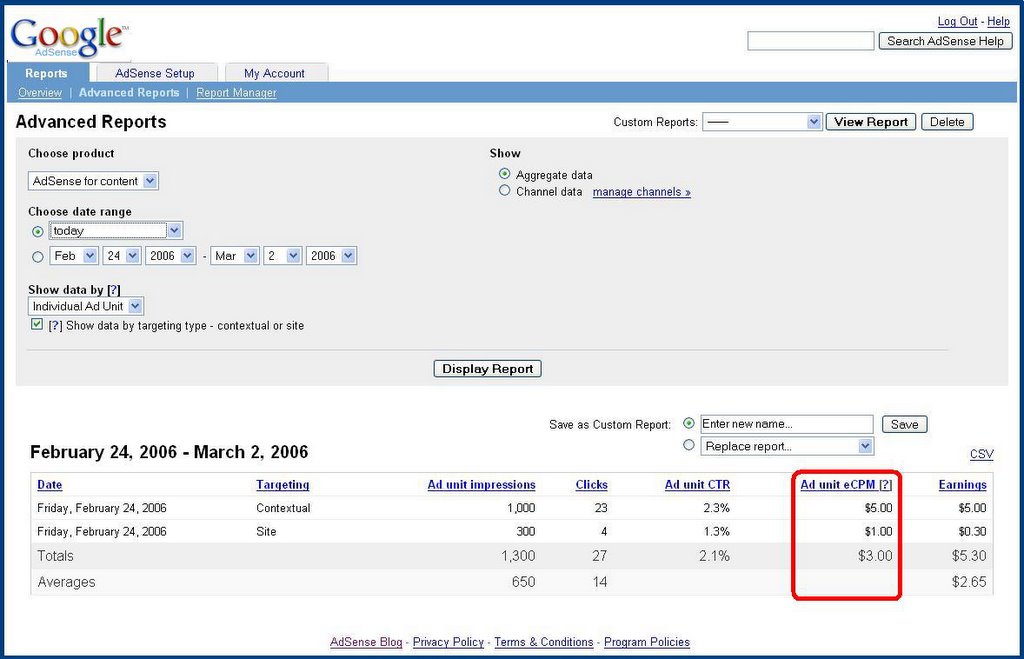
So why is the eCPM associated with site targeted ads sometimes lower than the eCPM associated with contextual ads in your Advanced Reports? The answer is that site targeted ads are most likely appearing on lower performing pages within your account – in other words, pages requiring a lower eCPM to win the AdWords ad auction. For example, say your ad unit on 'PageA.com' has an eCPM of $5.00, and a combination of contextually targeted ads are displaying. Your ad unit on 'PageB.com' has an eCPM of $1.00, and a site targeted ad is displaying because it represents the highest revenue potential for this page.

If these are the only two pages on which you are displaying AdSense ads, your Advanced Reports will show an eCPM of $5.00 for contextual ads, and an eCPM of $1.00 for site targeted ads. However, all of your ad units are automatically optimized to display the highest paying ads available at that moment.


Lastly, please remember that site targeted ads pay on a cost-per-thousand impressions (CPM) basis, not on a cost-per-click (CPC) basis, so you will be paid whether or not your visitors click on them. For site targeted ads, clickthrough rate does not affect eCPM since advertisers bid on a cost-per-thousand impression basis rather than a cost-per-click basis.

Souce Official Adsense Blog


Sunday, January 01, 2006

Adsense Tips for Bloggers 1

Is your blog suitable for Adsense? - Before you rush into signing up for Adsense expecting it to earn you a million dollars it is worth asking the question of whether Adsense is the right revenue strategy for your blog. By no means is it the only option - you might like to check out this tip on other ways of making money from blogging.


Whilst there are some amazing success stories about earning big dollars with Adsense out there, it is worth taking a realistic look at some cold hard truths about the Adsense program.


Google does not accept every site that applies to the Adsense program.


  • Google Adsense Program Policies indicate that the content of sites must not contain things like excessive profanity, pornography, illicit drugs etc. Basically your blog needs to have content that is reasonably ‘family friendly’.


  • Also in their policy document is a reference to them not normally accepting pages of a personal nature. This is the topic of discussion in many Adsense forums and is obviously open to different interpretations. Many (if not most) blogs are personal in nature - however to maximize your chances of approval by Adsense a blog should be targeted on a particular topic/s. For example whilst this blog is often personal in nature - most of my individual posts (pages) focus on very specific themes which are repeated throughout the blog. update - this may have changed recently with Blogger now allowing blogger blogs to use Adsense.


  • Sites accepted into the Adsense program are also required to be easily navigable, have an adequate quantity of text based content (don’t apply if you’ve been blogging a week) and be written in English, French, German, Italian, Dutch, Portuguese, Japanese, or Spanish. They may not to have excessive advertising or other contextual/competing advertising.


  • Whilst not stated in the Adsense Policy document, many also believe that sites accepted into the program also need to have reasonable levels of traffic. If your blog is new, it may be worth waiting a few weeks or months before applying to build up traffic and content levels. Others speculate that a professionally designed, well-organized and privately hosted blog has a better chance of being accepted. The more professional and successful your blog appears the more likely it is to be accepted by Adsense.


If still in doubt after reading Google Adsense Program Policies you can email Google for clarification or just apply and see how you go.


Of course, acceptance by Google into the Adsense program does not guarantee your success. The fact remains that certain blogs will always be more successful than others at generating income.


Subscribe to this blog's feed
[What is this?]